

Public field reference
Commercial Roof Storm Documentation Checklist
A practical way for commercial building teams to organize roof history before severe weather and preserve clear, dated information after an event - without confusing documentation with a professional determination.
How to use this resource
Build continuity before you need it.
This checklist is an operational organizer for owners, property managers, facility managers, commercial roofing contractors, roof consultants, risk managers, and insurance or claims stakeholders. Assign a record owner, store copies in more than one authorized location, and adapt the list to the roof system, warranty, safety program, and insurance instructions that apply to the property.
Safety comes first. Do not enter a damaged area or access a roof until the site is judged safe by the people responsible for the property and appropriate qualified professionals. Follow emergency officials, OSHA requirements, and site-specific controls.
Before severe weather
Preserve a usable baseline.
A current photo set is helpful. A dated, organized record tied to roof areas, repairs, and maintenance is stronger because it gives later reviewers something specific to compare.
Maintenance, repair, and warranty
Access and continuity
Event readiness
After severe weather
Document safely. Preserve sequence and source.
Start from a safe location and follow the property emergency plan. Documentation should preserve what was observed, when and where it was observed, and who created the record.
1. Control access and hazards
2. Open an event record
3. Capture observations before cleanup
4. Preserve the decision trail
Documents and files
Keep the evidence connected to the building.
Use durable names such as building-roof-area_YYYY-MM-DD_description. Preserve original files, working copies, and a short index that explains where each item came from.
Retain
- Roof plans, drawings, specifications, and drainage information
- Applicable warranties, guarantees, and manufacturer requirements
- Inspection, maintenance, repair, and closeout records
- Dated photos, video, maps, notes, and original file metadata
- Invoices, receipts, work orders, proposals, and approved scopes
- Event logs, public weather references, communications, and professional reports
People who may need the record
- Building owner, asset manager, property manager, and facility lead
- Safety or emergency-response personnel responsible for the site
- Commercial roofing contractor and applicable manufacturer or warranty contact
- Roof consultant, engineer, or other qualified professional
- Risk manager, broker, insurer, adjuster, or claims professional as applicable
- Legal or regulatory counsel when the owner determines it is appropriate
Baseline versus post-event
Comparison turns isolated files into a timeline.
A post-event photo shows a visible condition at one moment. A baseline-to-event comparison can show whether the same roof area was previously documented, what work occurred between dates, and where follow-up should be focused. It does not determine why a condition exists.
| Record element | Baseline record | Post-event record |
|---|---|---|
| Time | Dated reference before the event | Dated observations after the event |
| Location | Roof areas, features, prior concerns, and access limits | Same roof-area references plus new observations and access limits |
| Intervening history | Known inspections, maintenance, and repairs | Work, temporary protection, and decisions made since the baseline |
| Decision value | A reference point for planning and later review | A focused comparison for qualified reviewers and owner decisions |
A repeatable Commercial Roof Record.
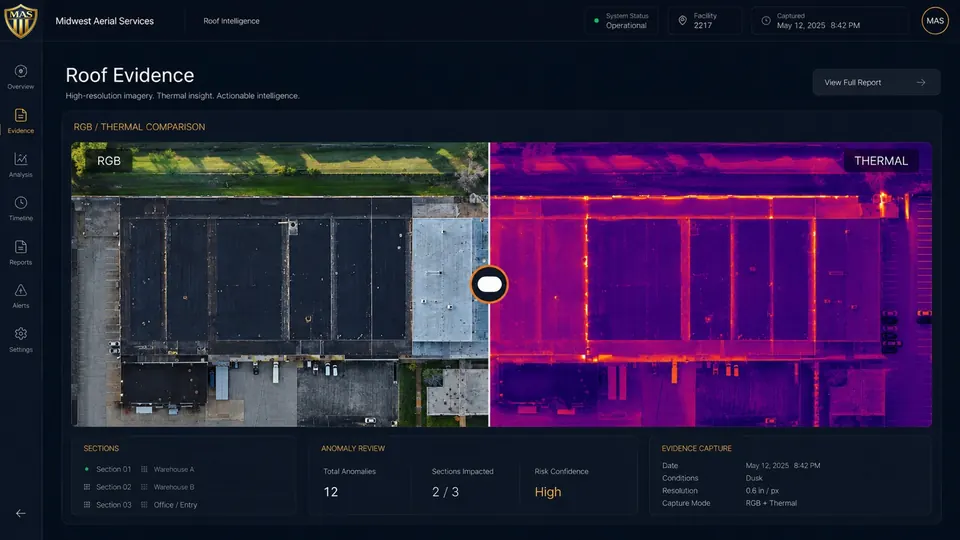
MAS can organize dated commercial roof imagery, mapped roof areas and observations, documentation notes, prior-record context, and thermal screening when conditions support it into a repeatable Roof Record. The record is designed to support owner, facility, contractor, consultant, and risk decisions over time.
Thermal patterns are screening evidence. They may identify areas for follow-up, but they do not by themselves prove moisture and should be field-confirmed where appropriate.
Documentation is not a determination.
- This checklist is general operational information, not legal, engineering, roofing, safety, insurance, or causation advice.
- It does not replace an adjuster, insurer, contractor, roof consultant, engineer, attorney, or other qualified professional.
- Public weather records provide context; they do not establish property-specific roof condition, loss timing, or storm causation.
- MAS documents observations and record continuity. MAS does not guarantee coverage, claim payment, repair outcome, or acceptance by another party.
- Always follow the applicable contract, warranty, policy, emergency plan, and professional direction for the property.
Print or download
Take the checklist into your planning meeting.
The two-page PDF is ungated. The web page is also print-safe and keeps the same practical checklist available without a form.
Primary sources
Guidance behind the checklist.
MAS reviewed primary government, insurer, manufacturer, and industry guidance current to August 26, 2026. The checklist paraphrases these sources; it does not quote them.
Relevant MAS next steps
See the record, then decide what your roof needs.
Review a public sample or tell MAS which commercial roof needs a baseline or post-event documentation plan.