System of record for commercial roof condition

Create the baseline. Track what changed. Keep every roof in one record.

Midwest Aerial Services creates a baseline for each commercial roof, compares storms and repairs to that baseline, and keeps the history in one portal so owners, facility teams, contractors, consultants, and insurers can act from shared evidence.

The drone is a sensor. The record is the product.

BaselineInstall the fixed starting point for the roof.
Event ReviewIsolate what changed after the event.
MonitoringTurn one-off inspections into continuity.
Why the current model fails

Most roof decisions fail before the meeting starts.

The problem is rarely a lack of images. The problem is fragmented dates, fragmented files, and fragmented interpretations. MAS replaces that with one roof record and one timeline.

Claims without baseline

When prior condition is undocumented, a storm conversation begins as an argument instead of a review.

Scope without shared evidence

Owners, contractors, consultants, and insurers often arrive with different files and different assumptions.

Capital without history

A roof ages across time. Budget and replacement decisions improve when that history is visible.

The operating workflow

Simple to explain. Strong enough to operate.

Keep the public story plain. MAS starts with baseline. Then later events, repairs, and recurring reviews attach to that same roof so the portal always has context.

01

Baseline

Document roof identity, capture context, artifact set, and first findings.

02

Event Review

Compare storms, repairs, or other events to the known baseline instead of memory.

03

Monitoring

Add scheduled checkpoints so condition drift and follow-up work remain visible.

04

Portal

Run queues, record state, permissions, and decision outputs from one operating layer.

Claim-ready evidence Repair and warranty context Portfolio visibility Repeatable record structure
Built around objects, states, and actions

The record model is what makes MAS feel enterprise-level.

The platform is organized around real assets, visible state, and next actions instead of isolated files. Stable nouns create trust. Stable workflow creates speed.

Portfolio
Property
Building
Roof
Baseline
Event
Artifact
Finding
Decision Pack
Action
Closeout
Example command view

One view for status, queue, and action.

Record coverage 92%
Missing baselines
3Roofs that still need a fixed starting point.
Open reviews
2Storm or repair comparisons waiting for review.
Pending closeouts
1Repair work that still needs final record updates.
Monitoring due
6Scheduled checkpoints due across active roofs.
Action queue
Warehouse 04Storm review pending documentation package.
Pending
Retail Plaza 9Repair closeout needs final upload.
In progress
Distribution Center BQuarterly review due this week.
Due now
Decision outputs
Claim package ready7 roofs
Repair scope context ready4 roofs
Capital review flagged5 roofs
Warranty follow-up open2 roofs
Representative proof

Show the model in three clear frames.

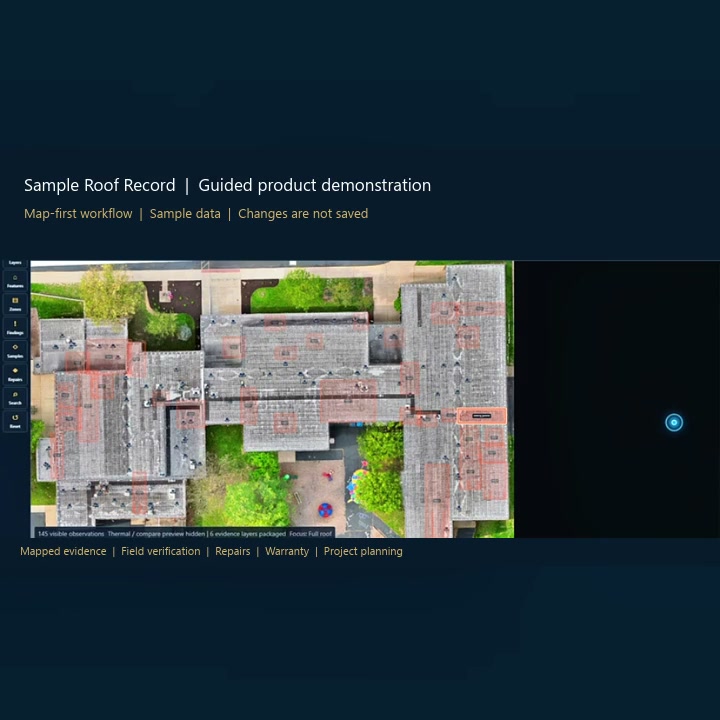
The public site should make the workflow obvious: raw roof, structured baseline, quantified delta. The goal is clear communication without pretending the public visual is a live client report.

Representative raw orthomosaic
01 · Raw captureStart with the roof as captured so everyone sees the same asset before interpretation begins.
Representative baseline map
02 · Structured baselineAdd zones, rooftop units, penetrations, and references so the record becomes navigable.
Representative quantified delta
03 · Quantified deltaWhen the next event happens, show what is new, where it is, and how much it changed.
Representative product visuals help explain the workflow. Live records stay in private review.
Governance posture

The record is more credible when control is visible.

Enterprise buyers care about more than images. They care about scope, permissions, history, and whether the record can support actual decisions.

Access scope

Keep records visible by building, roof, or portfolio so the right people see the right assets.

Audit history

Track when artifacts, findings, and decision packs are added or updated.

Review states

Open, in review, approved, closeout pending, and monitored keep work visible.

Decision exports

Claims, repair scope, closeout, and capital review should come from the same record.

Who it is built for

One roof record. Multiple stakeholders.

Owners

Reduce uncertainty, protect asset value, and make higher-consequence decisions from shared evidence.

Facility teams

Run review cadence, track follow-up work, and keep roof history organized in one place.

Consultants & contractors

Work from the same roof context instead of fragmented email threads and dated files.

Insurance & risk

Review pre-loss baseline and post-event change from one defensible timeline.

Start with one roof, one building, or one portfolio.

The cleanest first motion is still the baseline. It installs the record without forcing a large program on day one.